

Trauma-Informed Parenting Gains Ground as Psychologist Releases ACEs-Based Workbook
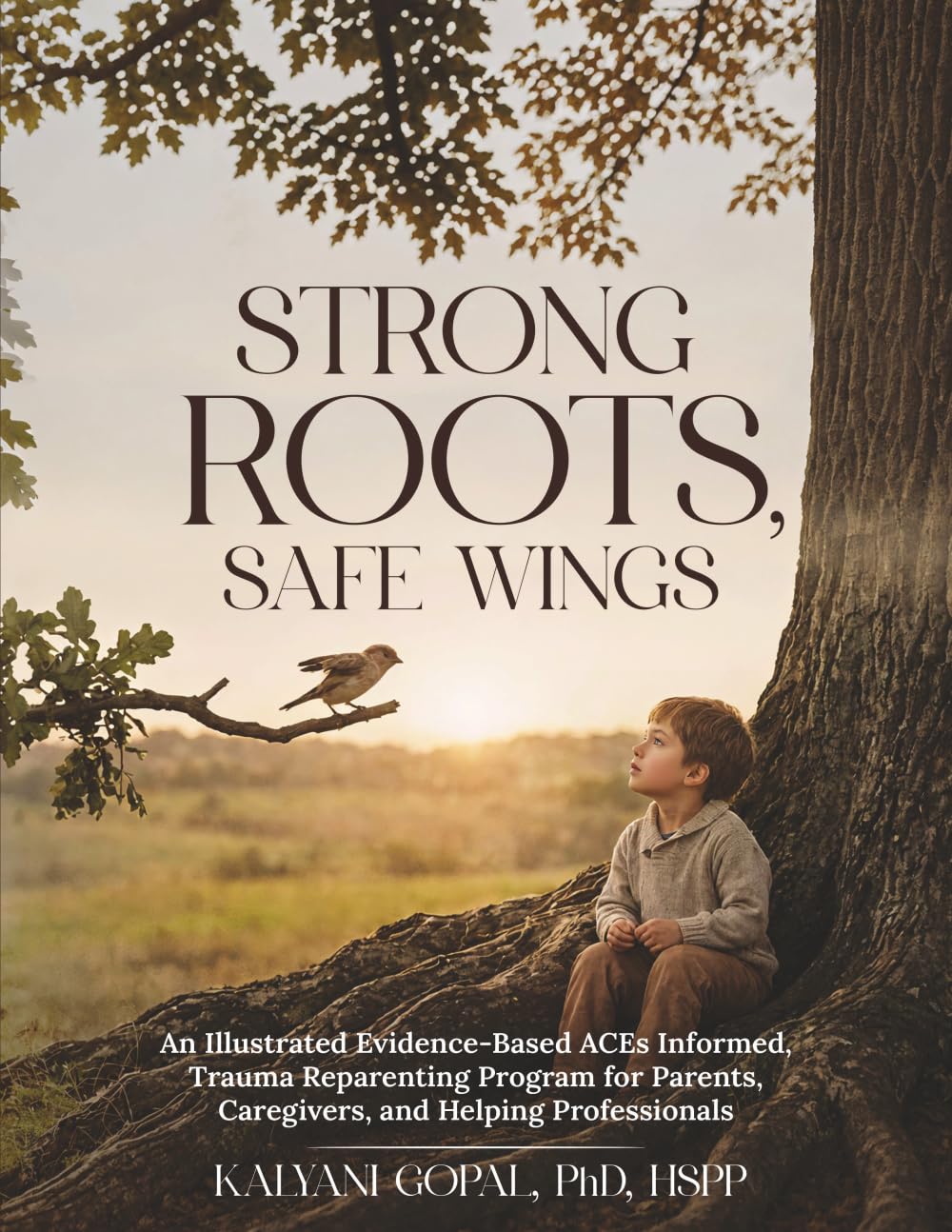
"Strong Roots, Safe Wings: An Illustrated Evidence-Based ACEs Informed, Trauma Reparenting Program for Parents, Caregivers and Helping Professionals" by Dr. Kalyani Gopal

Dr. Kalyani Gopal, author of "Strong Roots, Safe Wings: An Illustrated Evidence-Based ACEs Informed, Trauma Reparenting Program for Parents, Caregivers and Helping Professionals"
To change how we parent, we need to heal ourselves first, argues author Dr. Kalyani Gopal
“Strong Roots, Safe Wings: An Illustrated Evidence-Based ACEs Informed, Trauma Reparenting Program for Parents, Caregivers and Helping Professionals,” released this month, presents a structured, six-week program grounded in neuroscience, attachment theory and trauma research. Rather than focusing on discipline strategies or behavior management, the book centers on emotional regulation, self-awareness and what Dr. Gopal describes as “reparenting yourself” — a process aimed at interrupting cycles shaped by earlier life experiences.
The approach reflects a broader shift in the field. As research on ACEs has expanded, clinicians and educators have increasingly emphasized the role of early trauma in shaping adult responses, including those that emerge in parenting. Dr. Gopal’s work situates those findings within a practical framework, offering guided exercises, reflections and illustrated examples designed to translate theory into everyday interactions.
“Unlike other parenting books, ‘Strong Roots, Safe Wings’ is not as much about fixing your child,” Dr. Gopal says. “It’s about how you learn to react to your child in ways that bring you closer.”
Early reader responses describe the program as “a 6-week therapy session in a book,” emphasizing its structured yet manageable format, while others point to its focus on breaking “generational family trauma” and creating “healthier emotional patterns” within the home. Many find the book accessible and reassuring, “like sitting down with a compassionate therapist.”
Dr. Gopal’s emphasis on intergenerational healing is rooted in a career that spans more than three decades and multiple continents. She began her work at age 18, collecting data on exploited teenage girls in New Delhi, an experience that shaped her long-term focus on trauma, inequality and human rights.
Her work has since included training clinicians and government officials, consulting on trauma systems across four continents and leading initiatives addressing foster care, human trafficking and gender-based violence. She currently leads Mid-America Psychological and Counseling Services in Indiana and founded the SAFE Coalition for Human Rights, an accredited NGO with the United Nations focused on trauma-informed care and family support.
That combination of clinical, policy and frontline experience informs the framework presented in Strong Roots, Safe Wings. The book emphasizes that children’s emotional security is shaped less by isolated parenting techniques than by the consistency and regulation of the adults around them. It also challenges punitive or shame-based discipline models, instead encouraging caregivers to develop awareness of their own triggers and responses. The result is a book that focuses on underlying emotional patterns rather than surface-level solutions.
The workbook format reflects that intention. Through structured prompts and exercises, readers are guided to identify stress responses, explore their origins and practice alternative ways of responding in real time. The illustrated components aim to make complex psychological concepts more accessible, particularly for readers navigating fatigue or emotional overwhelm.
“It’s one thing to read a self-help book, but there’s no substitute for doing the deep work necessary to turn insights into experience and long-lasting change,” says Dr. Gopal. “That’s why I chose a workbook format, so parents can discover and actively recover from their own adverse experiences.”
At a time marked by what many describe as a widening mental health crisis — particularly among children and adolescents — the ideas explored in "Strong Roots, Safe Wings" reflect a growing emphasis on prevention, early intervention and the role of caregivers in shaping long-term outcomes. By focusing on the internal experiences of parents as much as the external behaviors of children, the book aligns with a broader shift toward understanding family systems as interconnected and adaptive.
As conversations around trauma, resilience and parenting continue to evolve, Dr. Gopal’s work positions the home as a critical site of change — one where, she suggests, healing may begin not with correction, but with awareness.
ABOUT DR. KALYANI GOPAL
Dr. Kalyani Gopal is a clinical psychologist, trainer and speaker with more than 35 years of experience working at the intersection of trauma, culture and human rights. Her work spans foster care, human trafficking, child sexual abuse and trauma-informed systems.
She is president of Mid-America Psychological and Counseling Services in Indiana and founder of the SAFE Coalition for Human Rights, an accredited NGO affiliated with the United Nations. Dr. Gopal has held leadership roles at the state, national and global levels, including president of the Illinois Psychological Association, president of the American Psychological Association’s Division 12 (Society of Clinical Psychology), and commissioner for the Committee on Accreditation for graduate psychology programs. She currently serves as president of the Psychology Coalition at the United Nations, where she works with organizations across regions to advance psychological research and practice globally.
Learn more at https://drkgopal.com/.
Dr. Kalyani Gopal
Author
drgopal@safechr.org
Legal Disclaimer:
EIN Presswire provides this news content "as is" without warranty of any kind. We do not accept any responsibility or liability for the accuracy, content, images, videos, licenses, completeness, legality, or reliability of the information contained in this article. If you have any complaints or copyright issues related to this article, kindly contact the author above.
